
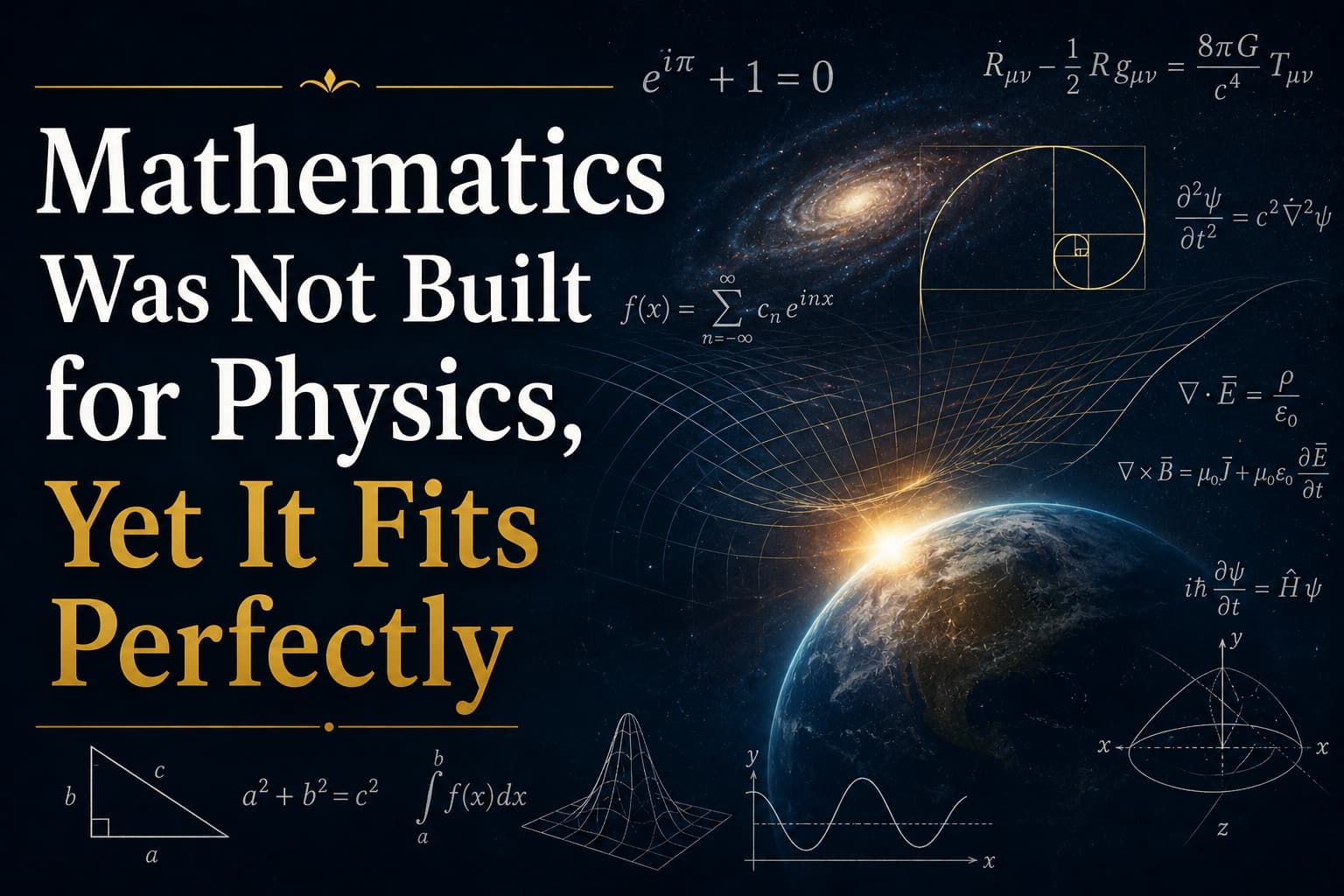
Mathematics Was Not Built for Physics, Yet It Fits Perfectly
One of the most striking facts about this phenomenon is that much of the mathematics used in modern physics was developed long before physicists had any use for it. Complex numbers were invented in the 16th century to solve abstract algebraic equations, yet they later became fundamental to quantum mechanics. Non-Euclidean geometry was developed as a purely theoretical exercise in the 19th century, yet Albert Einstein adopted it as the framework for his General Theory of Relativity. These are not isolated coincidences. They represent a recurring pattern in the history of science where abstract mathematics, created without any physical motivation, quietly waits until science is ready for it.
The Universe Appears to Be Written in Mathematical Language
One of the most striking facts about this phenomenon is that much of the mathematics used in modern physics was developed long before physicists had any use for it. Complex numbers were invented in the 16th century to solve abstract algebraic equations, yet they later became fundamental to quantum mechanics. Non-Euclidean geometry was developed as a purely theoretical exercise in the 19th century, yet Albert Einstein adopted it as the framework for his General Theory of Relativity. These are not isolated coincidences. They represent a recurring pattern in the history of science where abstract mathematics, created without any physical motivation, quietly waits until science is ready for it.
The Universe Appears to Be Written in Mathematical Language
The fundamental laws of physics, from Newton's laws of motion to Maxwell's equations of electromagnetism, from Einstein's field equations to Schrodinger's wave equation, are all expressed in precise mathematical form. These equations do not merely approximate physical behavior. In many cases, they predict it with extraordinary accuracy. No other branch of human knowledge comes close to this level of precision. This raises a profound question: is mathematics simply a useful tool that humans have created to describe patterns, or is it something deeper, the actual language in which the universe itself is written?
Competing Explanations and Why None Fully Satisfies
Several explanations have been put forward for mathematics' effectiveness, but none fully resolves the puzzle. One view holds that mathematics is effective simply because humans designed it to match patterns observed in nature, so the fit is not mysterious at all. A second view, held by thinkers such as mathematician Roger Penrose, argues that mathematical truths exist independently of human minds, and that the physical world genuinely conforms to these eternal structures. A third perspective suggests that we remember the cases where mathematics works and overlook the many cases where it does not. Each of these views captures something important, yet the mystery remains. The debate ultimately touches on some of the deepest questions in philosophy: What is mathematics? What is reality? And what does it mean that the human mind can discover truths about a universe it did not create?