
Why Every Business Needs Digital Transformation
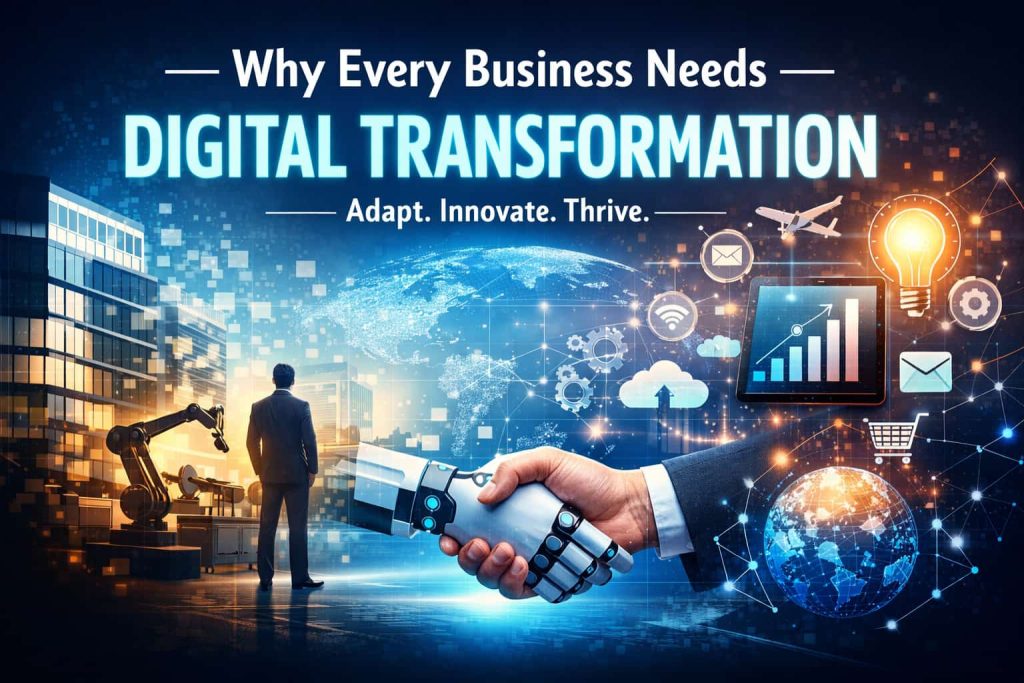
In today’s fast-paced, hyper connected world, digital transformation is no longer a trend—it is a strategic necessity. Businesses across every sector are being reshaped by technology, and the organizations that fail to adapt risk fading into irrelevance.
Digital transformation is not just about adopting new tools or software. It is about rethinking how a business operates, how it delivers value to customers, and how it positions itself for long-term growth in a digital economy.
At its heart, digital transformation is a mindset shift: moving from traditional, manual, and siloed ways of working to smarter, more agile, and data-driven operations.
- Customer Expectations Have Fundamentally Changed
Modern customers are digital-first. They expect convenience, speed, and personalization at every touchpoint. From ordering products online to receiving instant customer support, digital experiences now define how customers judge a brand.
If your business is not visible and accessible online, you are effectively invisible to a large segment of your market. Customers no longer want to wait in queues, fill out paper forms, or make repeated phone calls. They want seamless digital interactions.
Digital transformation enables businesses to:
- Offer online services and self-service platforms
- Communicate through multiple digital channels
- Provide faster and more consistent customer experiences
In essence, digital tools help businesses meet customers where they already are—online.
- Operational Efficiency Is the New Competitive Edge
One of the strongest arguments for digital transformation is efficiency. Traditional business processes are often slow, repetitive, and prone to human error. Manual data entry, physical record keeping, and fragmented communication systems drain productivity.
Digital systems streamline operations by automating routine tasks, integrating workflows, and centralizing information.
This leads to:
- Reduced operational costs
- Faster turnaround times
- Improved accuracy and consistency
- Better collaboration across teams
When processes are efficient, employees spend less time on administrative work and more time on strategic, value-adding activities.
Simply put, digital transformation allows businesses to do more with less.
- Data-Driven Decision Making
In the digital age, data is one of the most valuable assets a business can have. Every customer interaction, transaction, and internal process generates data that can be analyzed for insight.
Digital transformation equips organizations with tools to:
- Track performance in real time
- Understand customer behavior and preferences
- Identify inefficiencies and risks
- Forecast trends and opportunities
Without data, decision-making is based on intuition and guesswork. With data, decisions are informed, strategic, and measurable.
Data turns leadership from reactive to proactive.
- Staying Competitive in a Crowded Market
Competition today is no longer local—it is global. Customers can compare brands instantly, switch providers easily, and share experiences publicly.
Businesses that embrace digital transformation gain a clear competitive advantage by:
- Reaching wider audiences through digital channels
- Responding faster to market changes
- Innovating products and services more efficiently
- Building stronger customer relationships
Meanwhile, organizations that resist change struggle to keep up with more agile, tech-enabled competitors.
In a digital economy, standing still is the fastest way to fall behind.
- Scalability and Sustainable Growth
Traditional growth models often require significant increases in physical infrastructure, staffing, and overhead. Digital businesses, on the other hand, can scale rapidly with relatively lower costs.
Cloud systems, digital platforms, and automation allow businesses to:
- Serve more customers without increasing complexity
- Expand into new markets with minimal barriers
- Adapt quickly to demand fluctuations
Digital transformation creates a foundation for sustainable growth—growth that is flexible, resilient, and future-proof.
- Workforce Empowerment and Innovation
Contrary to common fears, digital transformation is not about replacing people with machines. It is about empowering employees with better tools, clearer processes, and more meaningful work.
Digital workplaces enable:
- Remote and hybrid work
- Faster communication and collaboration
- Continuous learning and upskilling
- A culture of innovation and experimentation
When employees are supported by technology, they become more productive, more creative, and more engaged.
- Risk Management and Business Continuity
Digital systems also strengthen resilience. Businesses with digital infrastructure are better equipped to handle disruptions—whether from economic shifts, global crises, or operational challenges.
With cloud storage, cybersecurity systems, and digital communication platforms, organizations can:
- Protect critical data
- Maintain operations remotely
- Recover faster from disruptions
- Reduce dependency on physical systems
Digital transformation is not just about growth—it is also about survival.
The Inevitable Path Forward
Digital transformation is no longer optional. It is not a project with an end date—it is a continuous journey of improvement, adaptation, and reinvention.
The real question is no longer “Should we transform?”
It is “How fast can we transform before the market leaves us behind?”
Businesses that embrace digital transformation today position themselves as leaders of tomorrow—agile, intelligent, and ready for a future that rewards innovation over tradition.
In the digital age, the strongest organizations are not the biggest—they are the ones most willing to evolve.
Perfect—that’s the cleanest and most professional approach.
References
- Image inovation. (2023). What is Digital Transformation and Why It Is Important for Businesses.
Retrieved from: https://imaginovation.net/blog/what-is-digital-transformation-importance-for-businesses/ - WiFi Talents. (2024). Digital Transformation Statistics in the Business Industry.
Retrieved from: https://wifitalents.com/digital-transformation-in-the-business-industry-statistics/ - Microsoft. (2023). What Is Digital Transformation?
Retrieved from: https://www.microsoft.com/en-us/microsoft-365/business-insights-ideas/resources/what-is-digital-transformation - MIT Sloan Management Review. (2022). Revamping Your Business Through Digital Transformation.
Retrieved from: https://sloanreview.mit.edu/article/revamping-your-business-through-digital-transformation/ - Vial, G. (2019). Understanding Digital Transformation: A Review and Research Agenda.
MIS Quarterly, 43(1), 223–247. - Kane, G. C., Palmer, D., Phillips, A. N., Kiron, D., & Buckley, N. (2015). Strategy, Not Technology, Drives Digital Transformation.
MIT Sloan Management Review.