
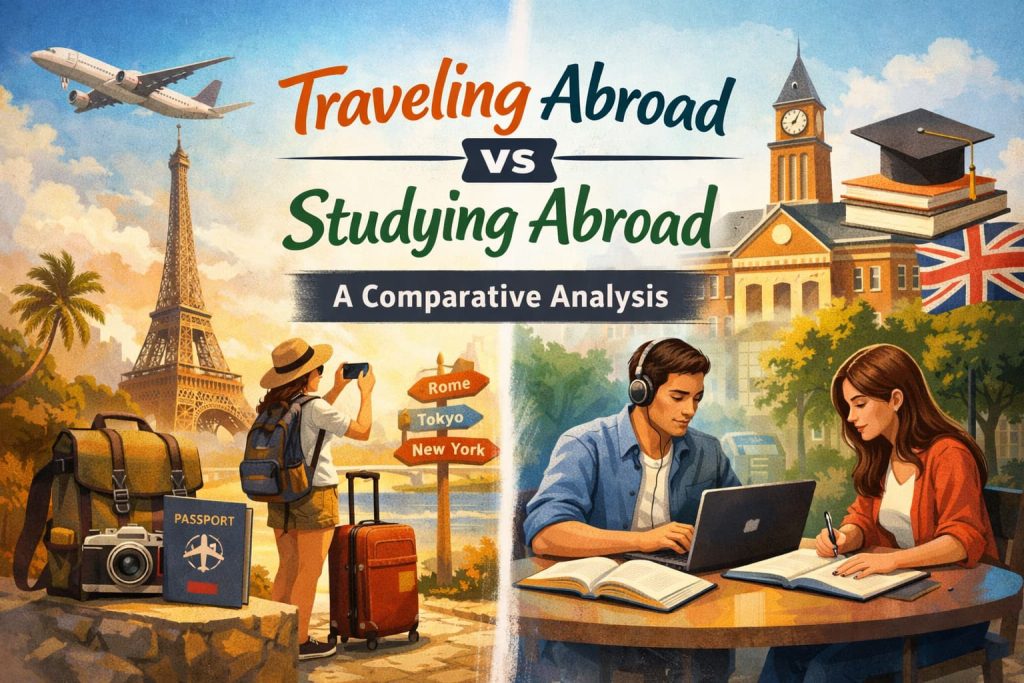
Traveling Abroad vs Studying Abroad A Comparative Analysis
Traveling abroad and studying abroad both involve leaving one’s home country to experience a new environment, but they differ significantly in purpose, structure, duration, and outcomes. While both provide exposure to different cultures and lifestyles, one is primarily focused on exploration and leisure, whereas the other combines academic learning with cultural immersion. Understanding these differences is important when making decisions based on personal goals, financial capacity, and long-term aspirations.
Key Definitions
Traveling Abroad refers to visiting foreign countries for purposes such as tourism, leisure, adventure, cultural exploration, or personal discovery. It may involve short vacations, backpacking trips, or gap-year travel. The experience is generally flexible and self-directed, allowing individuals to decide where to go, how long to stay, and what activities to engage in. The main emphasis is enjoyment, exploration, and freedom rather than formal learning or structured outcomes.
Studying Abroad, on the other hand, involves enrolling in an academic program in a foreign country. This could be a short-term exchange program, a semester abroad, or a full degree program. Students attend classes, complete assignments, and earn academic credits from a recognized institution. In addition to education, studying abroad also provides cultural exposure through daily life, interaction with local students, and participation in structured activities. Unlike travel, it is guided by academic schedules and institutional requirements.
Purpose and Structure
The primary difference between the two experiences lies in purpose and structure. Traveling abroad is flexible and leisure-driven, with no fixed academic or professional obligations. Individuals can modify their plans at any time, making it ideal for exploration and relaxation.
Studying abroad is structured and goal-oriented. It is designed to contribute to academic and professional development. Students must follow a timetable, meet deadlines, and fulfill academic requirements. Although it allows for cultural exploration, it is secondary to academic responsibilities.
Duration and Commitment
Traveling abroad is usually short-term, ranging from a few days to several months depending on budget and personal preference. Extended travel is possible but remains flexible and self-funded.
Studying abroad typically lasts longer, from a semester to several years in the case of full degree programs. It requires a higher level of commitment, as students must remain enrolled and maintain academic performance throughout the duration of their program.
Advantages and Disadvantages
Traveling Abroad Advantages:
– Provides full freedom to choose destinations, activities, and pace.
– Can be more affordable depending on travel style and budgeting.
– Offers relaxation and adventure without academic pressure.
– Allows spontaneous decision-making and flexible planning.
Traveling Abroad Disadvantages:
– Limited structured cultural or educational immersion.
– No academic credit or formal qualification gained.
– Can involve logistical challenges such as visas, safety, and accommodation planning.
– May feel isolating without a built-in community.
Studying Abroad Advantages:
– Combines education with cultural exposure.
– Provides academic credit and enhances qualifications.
– Develops independence, adaptability, and global awareness.
– Offers structured support systems and organized student communities.
– May lead to internships, research opportunities, or international careers.
Studying Abroad Disadvantages:
– Requires managing academic workload alongside cultural adjustment.
– Can be expensive due to tuition and program fees.
– Less flexibility in schedule and travel opportunities.
– Possibility of homesickness, culture shock, or language barriers.
Social and Personal Development
Traveling abroad often promotes self-discovery through independence and exposure to unfamiliar environments. However, interactions may be brief and less structured.
Studying abroad typically encourages deeper social integration. Students often live in shared housing, attend regular classes, and form long-term friendships. This environment fosters stronger cultural understanding and personal growth through sustained interaction.
Which Should You Choose?
The choice depends largely on personal goals. Traveling abroad is ideal for freedom, adventure, and short-term exploration, while studying abroad is more suitable for academic advancement and structured cultural immersion.
A hybrid approach is also possible, combining academic study with travel during breaks or after completing studies.
Conclusion
Both experiences broaden perspectives and build independence. Traveling emphasizes freedom and exploration, while studying abroad focuses on academic growth and structured development. The best choice depends on financial readiness, career goals, and personal preference.