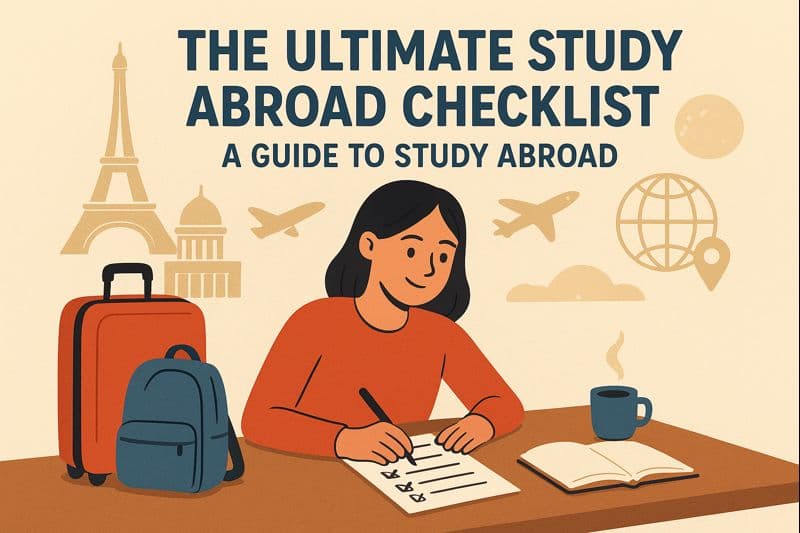
Every year, thousands of students land their dream acceptance letter, only to discover that the real battle isn’t getting in but it’s actually being allowed to go.
Most people head into the process with zero clue about blocked accounts, apostilles, weird photo rules, or proof that they won’t study abroad. The result? Delayed visas, rejected applications, and full-on meltdowns at the embassy.
Many people are victims of these meltdowns and here is a guide put together to avoid delays.
Phase 1: Before Application
- Valid passport (at least 6–18 months validity left)
- High school & university transcripts (official, sealed)
- Degree/diploma (plus certified translations if not in English)
- Language test results (book these 4–6 months early!): → IELTS / TOEFL / PTE (most English-speaking countries) → TestDaF, Goethe C1 (Germany) | DELF/DALF B2–C1 (France) | DELE (Spain) | HSK (China) | JLPT (Japan)
- Standardized tests if required (GRE, GMAT, SAT, etc.)
- 2–3 strong recommendation letters
- Killer Statement of Purpose / Motivation Letter
- CV + portfolio (art/design/architecture kids, this is your golden ticket)
Phase 2: You Got Accepted — Now the Real Paperwork Begins
- Unconditional offer letter from the university
- Passport-sized photos (check exact mm size, the countries are weirdly strict)
- Proof of money: ├ Germany → €11,904 in a blocked account (Deutsche Bank, Fintiba, Expatrio, Coracle, etc.) ├ France → ~€615/month (bank statement or sponsor) ├ Netherlands → €1,000–€1,200/month ├ Canada → CAD 20,635 + tuition (for study permit) ├ Australia → AUD 24,505 + tuition + OSHC health insurance ├ UK → £1,334/month (London) or £1,023 (elsewhere) × 9 months └ USA → Whatever your I-20 says (usually $40k–$70k)
- Health insurance (non-negotiable)
- EU: private policy with €30,000+ coverage or EHIC if you’re European
- Germany: public (Tk, AOK, Barmer) or private German insurance
- USA/Canada/Australia: university plan or equivalent
- Accommodation proof (first 3–12 months — some embassies are picky)
- Police clearance certificate (Australia, Canada, NZ, sometimes UK)
- TB test / chest X-ray (UK, Australia, Canada, NZ, Korea)
- Vaccination record (COVID, MMR, sometimes Yellow Fever)
Phase 3: Practical Money & Life Setup
- Open a Wise or Revolut account NOW (you’ll thank me when you avoid 8 % bank fees)
- Get a no-foreign-transaction-fee debit/credit card
- Bring 2–3 backup cards (and keep them in separate places)
- Have €/£/$500–1000 cash for the first week (ATMs can fail)
- ISIC card (International Student Identity Card) = discounts everywhere
Phase 4: After You Landing
- Register residence/address (Germany Anmeldung, France OFII, Italy Questura, etc.)
- Apply for residence permit if your stay > 90–180 days
- Get a local SIM card on day 1 (eSIMs like Airalo are clutch)
- Open a local bank account (often needed for rent or part-time jobs)
- Get your student transport pass (saves hundreds per semester)
Bonus: Timeline That Actually Works
- 12–9 months before: research programs, take language/test exams
- 9–6 months before: apply to universities
- 6–4 months before: accept offer, open blocked account, book visa appointment
- 4–2 months before: gather medical tests, police certificate, translations
- 1 month before: book flights, pack, cry a little
- 1 week before: print EVERY document in duplicate