
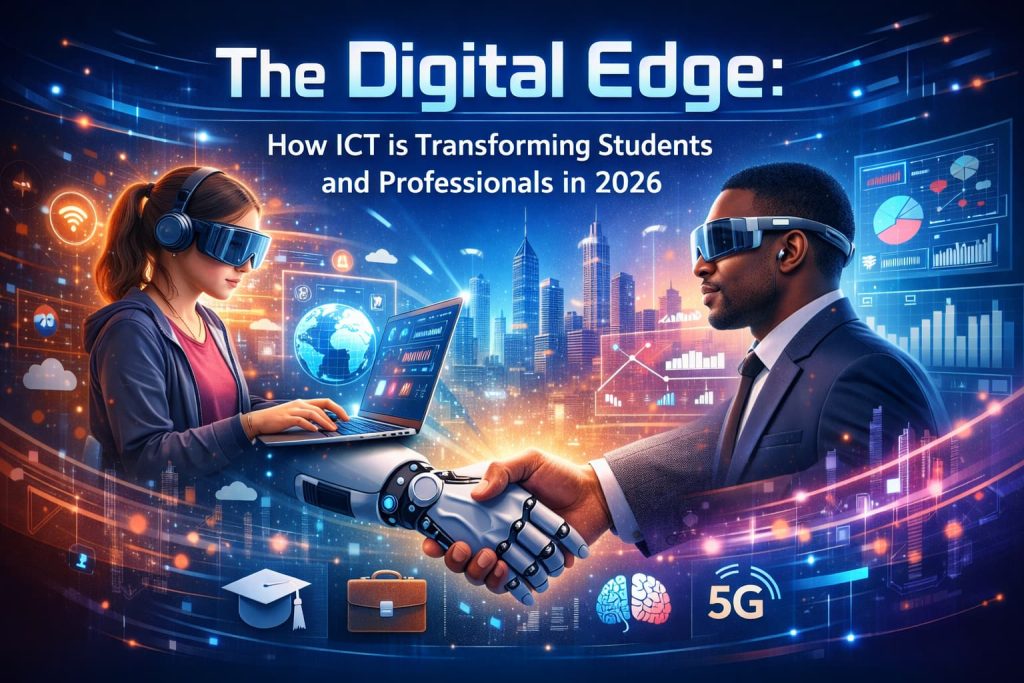
The Digital Edge: How ICT is Transforming Students and Professionals in 2026
In 2026, the term “ICT” (Information and Communication Technology) has moved beyond being a mere school subject or an IT department jargon. It is the very fabric of our daily productivity. Whether you are a student navigating the complexities of modern academia or a professional climbing the corporate ladder, ICT is no longer just an advantage, it is a requirement.
Here is how ICT is specifically reshaping these two worlds this year.
1. ICT for Students: Beyond the Digital Textbook
For today’s students, ICT has turned the world into a borderless classroom. The focus has shifted from “learning about technology” to “learning through technology.”
- AI-Powered Personalized Learning: With the integration of Generative AI and adaptive learning platforms, students now have 24/7 personal tutors. These systems identify a student’s weak points in real-time and adjust the curriculum to match their pace.
- Immersive Education (VR/AR): History and Science are no longer static. Through Virtual Reality, students can “walk” through Ancient Rome or visualize the molecular structure of a virus in 3D, leading to a 20-40% increase in learning retention compared to traditional methods.
- Global Collaboration: Digital platforms allow a student in Lagos to collaborate on a research project with a peer in Tokyo. This fosters “soft skills” like cross-cultural communication and remote teamwork, which are essential for the future workforce.
- Micro-credentials: In 2026, students are increasingly using ICT to earn “digital badges” and micro-certifications from platforms like Coursera or LinkedIn Learning alongside their degrees, allowing them to specialize in niche fields like Data Ethics or Prompt Engineering.
2. ICT for Professionals: Efficiency in the Age of Automation
For the professional, ICT is the engine of “Smart Work.” It’s about doing more with less and staying relevant in a fast-evolving market.
- The Rise of the Hybrid Office: ICT tools like advanced cloud computing and 5G/6G connectivity have made “work from anywhere” seamless. Virtual workspaces now feature spatial audio and AI-driven noise cancellation, making remote meetings feel as natural as in-person ones.
- Data-Driven Decision Making: Professionals are no longer relying on “gut feelings.” Tools like Power BI and AI-enhanced Excel allow even non-tech employees to analyze massive datasets and visualize trends, turning raw information into strategic business moves.
- Automation of Routine Tasks: From AI assistants that schedule meetings to automated “smart” workflows that handle invoicing, ICT frees up professionals to focus on high-value, creative, and strategic tasks.
- Cyber security Literacy: As work goes digital, cyber security has become a core professional skill. Knowing how to protect sensitive company data is now as fundamental as knowing how to send an email.
3. The 2026 Perspective: Balancing Progress with Well-being
While the benefits are immense, the conversation in 2026 has shifted toward Digital Well-being. As highlighted in a recent 2025/2026 study published by MDPI Education Sciences, the challenge is ensuring that technology supplements, rather than replaces, critical thinking and human interaction.
“The goal of ICT integration in 2026 is not just efficiency; it is about human empowerment. We must use AI to enhance our creativity, not to outsource our thinking.”
Summary Table: ICT Benefits at a Glance
Feature | For Students | For Professionals |
Primary Tool | AI Tutors & LMS | Cloud Collab & Data Analytics |
Core Benefit | Personalized Pace | Increased Productivity |
Skill Gained | Digital Literacy | Operational Efficiency |
Future Impact | Career Readiness | Global Competitiveness |
Reference
University of the Potomac (2025). “How Does Technology Impact Student Learning Outcomes?” & IMD Business School (2025). “The Future of Work: Trends and Insights for 2025/2026.”