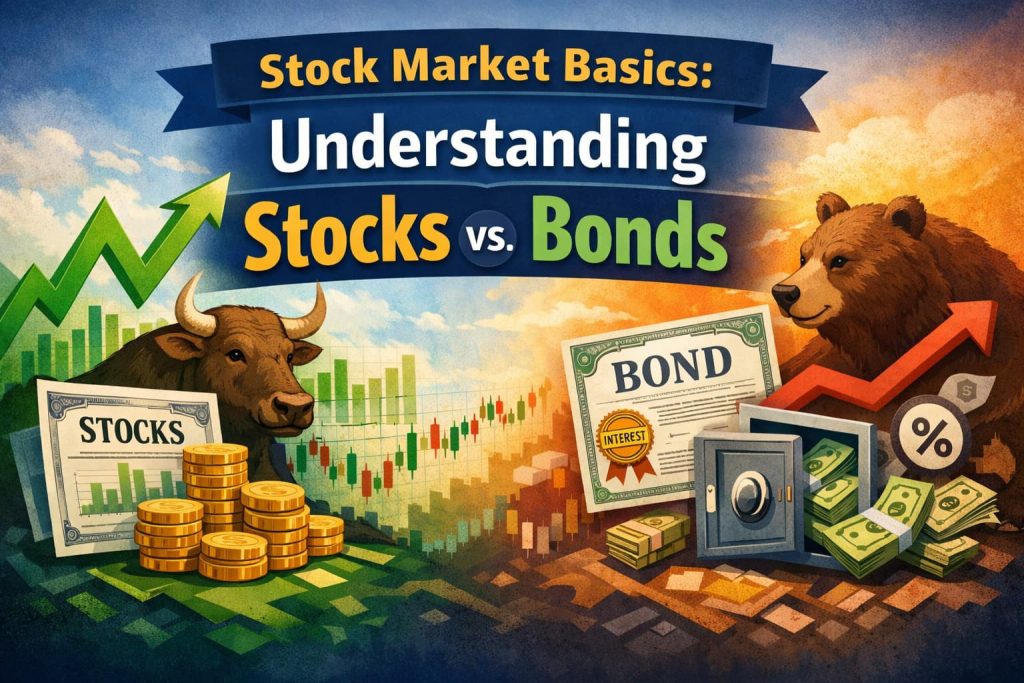
Stock Market Basics Understanding Stocks vs. Bonds
Investing is no longer reserved for financial experts or large institutions, it has become an essential skill for individuals and organizations aiming for long-term growth and sustainability. Whether you’re managing personal finances or contributing to an organization like Valdymas Entrepreneurial and Transformational Leadership Empowerment Program ( VETLEP ), understanding the fundamentals of the stock market is a critical step toward making informed financial decisions.
In this blog, we’ll explore the basics of stocks and bonds, highlight their key differences, and connect these concepts to how VETLEP can leverage them for financial growth and stability.
What Are Stocks?
Stocks, also known as equities, represent ownership in a company. When you purchase a stock, you are essentially buying a small share of that company.
Key Characteristics of Stocks:
- Ownership: Shareholders own a portion of the company.
- Potential for High Returns: Stocks can appreciate significantly over time.
- Dividends: Some companies distribute profits to shareholders.
- Higher Risk: Stock prices can be volatile due to market conditions.
Example: If VETLEP invests in stocks of a growing Fintech company, it could benefit from rising share prices and dividends but it also faces the risk of market downturns.
What Are Bonds?
Bonds are fixed-income instruments that represent a loan made by an investor to a borrower (typically governments or corporations).
Key Characteristics of Bonds:
- Lending Relationship: Investors lend money in exchange for interest payments.
- Fixed Returns: Bonds usually provide predictable income.
- Lower Risk: Generally less volatile than stocks.
- Maturity Date: Bonds are repaid at a specified future date.
Example: If VETLEP invests in government bonds, it earns steady interest income with minimal risk, making it a safer option for preserving capital.
Stocks vs. Bonds: Key Differences
| Feature | Stocks | Bonds |
| Ownership | Yes (equity in a company) | No (loan to issuer) |
| Risk Level | Higher | Lower |
| Returns | Variable (capital gains + dividends) | Fixed (interest payments) |
| Volatility | High | Low |
| Income Stability | Uncertain | Predictable |
Why This Matters for VETLEP
As a financial-focused organization, VETLEP plays a crucial role in managing funds, supporting members, and ensuring sustainable growth. Understanding stocks and bonds can directly enhance its financial strategy.
1. Diversified Investment Strategy
VETLEP can balance its portfolio by combining stocks (for growth) and bonds (for stability), reducing overall risk.
2. Sustainable Financial Growth
Stocks can help VetLEP grow its capital over time. Bonds can provide steady income to support operations and member payouts.
3. Risk Management
By allocating funds strategically between stocks and bonds, VETLEP can protect itself against market volatility while still pursuing growth opportunities.
4. Member Education
VETLEP can extend this knowledge to its members, empowering them with financial literacy and investment awareness aligning with its broader mission of financial inclusion.
Practical Application for VETLEP
A balanced investment approach might look like:
- 60% in bonds (to ensure steady income and capital preservation)
- 40% in stocks (to drive long-term growth)
This type of allocation helps VETLEP maintain liquidity while still benefiting from market opportunities.
Conclusion
Understanding the difference between stocks and bonds is fundamental to making smart investment decisions. While stocks offer higher growth potential with increased risk, bonds provide stability and predictable income. For an organization like VETLEP, combining both instruments can create a resilient and growth-oriented financial strategy.
By integrating these principles, VETLEP not only strengthens its financial position but also sets a powerful example for its members promoting financial literacy, smart investing, and long-term wealth creation.
References
- (2023). Stocks vs Bonds: What’s the Difference?
- Mankiw, N. G. (2021). Principles of Economics. Cengage Learning.
- Nigerian Exchange Group (NGX). (2023). Understanding Capital Markets in Nigeria
- SEC Nigeria. (2022). Investor Education Handbook
- Kolawole, J. (2023). Transforming the Impossible