
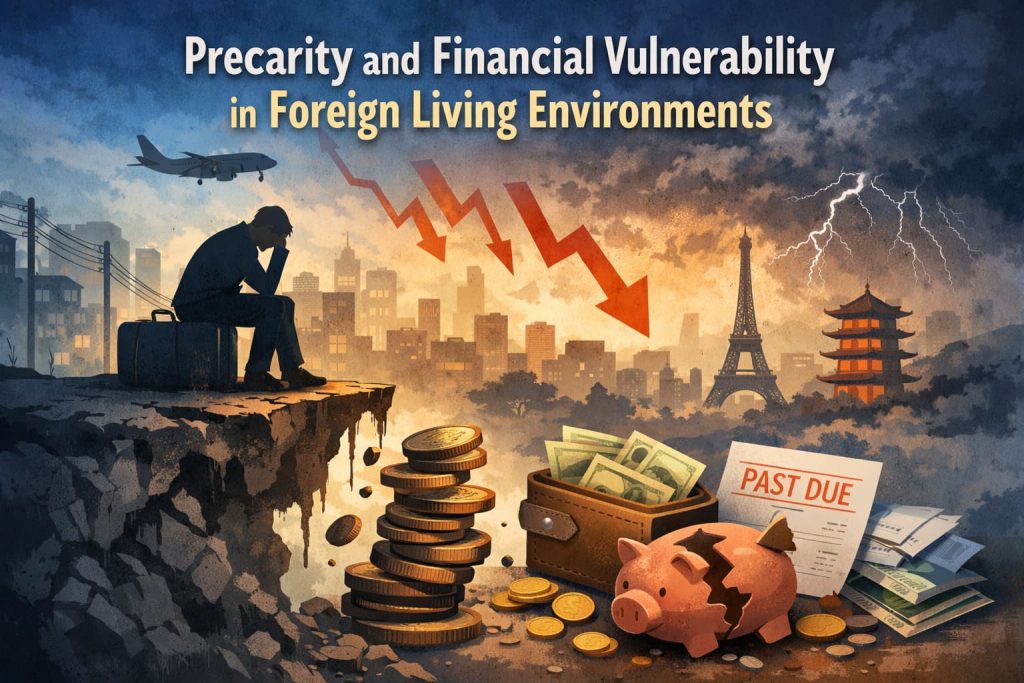
Precarity and Financial Vulnerability in Foreign Living Environments
In today’s globalized higher education landscape, millions of students pursue studies abroad in foreign living environments whether in major destinations like the United States, United Kingdom, Australia, Canada, or emerging hubs in Europe and Asia. While this mobility promises academic growth, cultural enrichment, and career advancement, it often comes with significant precarity and financial vulnerability. Precarity refers to conditions of uncertainty, instability, and exposure to risk, particularly in economic and social domains, while financial vulnerability describes the heightened susceptibility to economic shocks due to limited resources, restricted access to support, and structural barriers.
International students frequently encounter these challenges in amplified ways compared to domestic peers. As non-citizens, they navigate visa restrictions, limited work rights, ineligibility for many public benefits or financial aid programs, and reliance on personal/family funds or precarious employment. Recent data and studies highlight that these issues persist and, in some cases, intensify amid rising costs, policy shifts, and economic pressures.
Key Sources and Dimensions of Precarity and Financial Vulnerability
High Costs of Living and Tuition in Host Countries
Studying abroad often involves substantial expenses: inflated international tuition fees, soaring housing costs in urban centers, food, transportation, health insurance, and other essentials. In many popular destinations, rent and living expenses have outpaced inflation, exacerbated by housing shortages.
Students from lower-income or middle-income countries face compounded strain when home currencies weaken against host currencies, making remittances costlier and reducing purchasing power. Recent reports note that rising tuition and proof-of-funds requirements in traditional destinations (e.g., US, UK, Canada, Australia) are prompting students to reassess options or face acute financial pressure.
Restricted Access to Work and Precarious Employment
Many students rely on part-time work to offset costs, but visa regulations often cap hours (e.g., 20 hours/week during term time in several countries) and restrict job types. This pushes them toward low-wage, unstable sectors like hospitality, retail, or gig work positions prone to exploitation, irregular hours, and sudden loss during economic downturns or crises.
Studies from Australia and Canada show that financial precarity is higher among students from low-GNI (gross national income) countries, working-class backgrounds, or those in vocational/non-university programs without scholarships. Work precarity intersects with non-citizenship status, limiting bargaining power and access to labor protections.
Limited Safety Nets and Support Systems
Unlike domestic students, internationals are often ineligible for government subsidies, emergency aid, student loans, or welfare benefits. Scholarships remain scarce and competitive. Banking barriers—such as lack of credit history—hinder access to affordable accounts, credit, or contracts for housing/utilities. International transfers incur high fees and currency risks.
During disruptions (e.g., pandemics, policy changes, or recessions), these gaps widen dramatically. Loss of part-time jobs or family support can lead to skipping meals, accruing debt, or even housing instability like “hot-bedding” (sharing beds in shifts) or eviction fears.
Intersecting Vulnerabilities and Broader Impacts
Financial strain rarely exists in isolation. It frequently compounds psychological stress (anxiety, depression), academic performance declines, and social isolation. Surveys indicate that highly precarious students report negative effects on studies, health, and well-being. In extreme cases, it contributes to dropout risks or return migration under duress.
Precarity is differentiated: students from wealthier backgrounds or with scholarships experience less severity, while those from Global South countries or in lower-tier programs face heightened risks. This challenges earlier assumptions of international students as uniformly “privileged” or middle-class.
Contemporary Context and Trends
Between 2025 and 2026, international student mobility rebounds post-pandemic but faces headwinds. Enrollment declines in some major destinations (e.g., sharp drops in new US enrollments linked to visa policies and restrictions) highlight growing uncertainty. While international students contribute billions economically to host countries (supporting jobs in education, housing, retail, etc.), their own financial positions remain fragile. Policy volatility—tighter visas, work-hour changes, or immigration scrutiny—further heightens precarity for those already abroad or considering it.
Diversifying destinations (e.g., toward Asia or Europe with more affordable options and flexible work rights) offers alternatives, but core issues like structural inequities persist across borders.
Why Addressing This Matters
Precarity and financial vulnerability undermine the promise of global education: equitable access, personal development, and cross-cultural exchange. They can deter talented students, reduce diversity in campuses, and harm host economies reliant on international tuition and spending. For students, navigating these challenges builds resilience but often at great personal cost.
Ultimately, fostering more secure foreign living environments requires systemic changes: expanded scholarships, fairer work policies, affordable housing initiatives, mental health support tailored to internationals, and recognition of their contributions beyond economic metrics. In an interconnected world, reducing precarity ensures that the pursuit of knowledge abroad is empowering rather than precarious for all.