
Note-Taking Methods That Improve Memory
In a world filled with constant information, remembering what we learn has become a real challenge. Whether you are a student, teacher, researcher, or professional, effective note-taking is one of the most powerful tools for improving memory and understanding. Good notes do more than record information they help your brain process, organize, and retain knowledge. Below are proven note-taking methods that significantly improve memory.
1. The Cornell Note-Taking Method
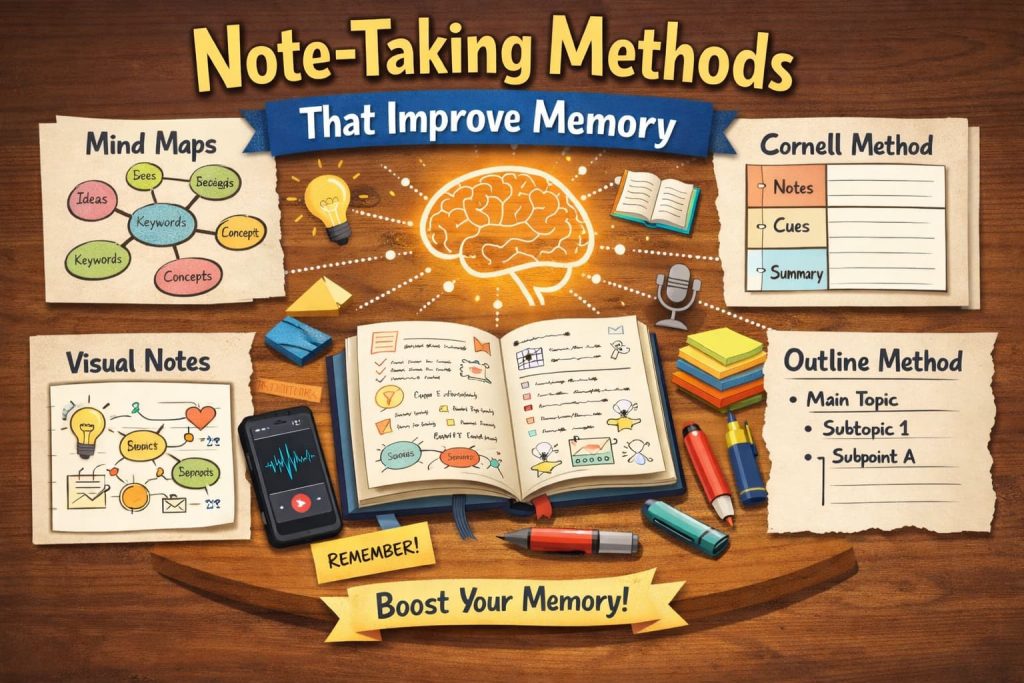
The Cornell Method divides a page into three sections: cues, notes, and summary. During a lecture or reading, you write key points in the main notes section. Afterward, you create questions or keywords in the cue column and write a brief summary at the bottom.
Why it improves memory:
This method encourages active recall and reflection, which strengthens long-term memory. Reviewing cue questions helps you test yourself rather than passively rereading notes.
2. Mind Mapping
Mind mapping involves writing a central idea in the middle of the page and branching related concepts outward using keywords, symbols, and colors. It visually shows how ideas are connected.
Why it improves memory:
The brain remembers images and patterns better than long texts. Mind maps engage both creative and logical thinking, making information easier to recall.
3. The Outline Method
This method organizes notes in a structured, hierarchical format using headings, subheadings, and bullet points. Main ideas are written on the left, while supporting details are indented.
Why it improves memory:
The clear structure helps the brain understand relationships between ideas, making recall faster and more accurate during revision.
4. The Charting Method
The charting method uses tables or columns to organize information, especially when comparing topics, concepts, or theories.
Why it improves memory:
Grouping related information reduces cognitive overload and helps learners quickly identify patterns and differences.
5. The Sentence Method
With this method, each new piece of information is written as a separate sentence, usually in chronological order.
Why it improves memory:
Although simple, it keeps learners actively listening and writing. When reviewed later, sentences can be reorganized into more structured formats.
6. Active Note-Taking (The Feynman Technique)
This approach involves writing notes in your own words as if you are teaching someone else. After studying, you explain the concept using simple language.
Why it improves memory:
Teaching forces deeper understanding. When you simplify ideas, your brain forms stronger connections, making recall easier.
7. Digital Note-Taking with Purpose
Using digital tools like Notion, OneNote, or Google Docs allows you to organize, tag, and revisit notes easily. However, typing should not replace thinking.
Why it improves memory:
When combined with summarizing, highlighting key ideas, and reviewing regularly, digital notes support spaced repetition and long-term retention.
Tips to Maximize Memory While Taking Notes
Use your own words instead of copying verbatim
Highlight keywords, not entire sentences
Review notes within 24 hour
Combine methods when necessary
Ask questions in your notes
Conclusion
Effective note-taking is not about writing everything down but about engaging your brain in the learning process. By choosing the right note-taking method and reviewing consistently, you can significantly improve your memory, understanding, and academic or professional performance. Start experimenting with these methods and discover which one works best for you.