
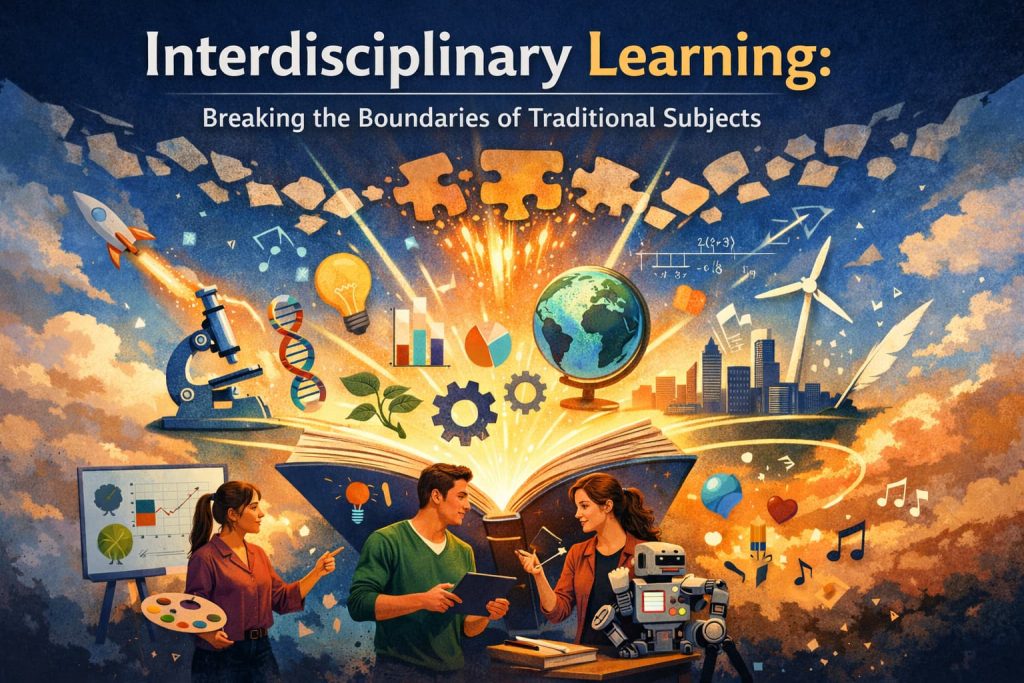
Interdisciplinary Learning Breaking the Boundaries of Traditional Subjects
Interdisciplinary learning represents a shift from traditional education systems where subjects such as mathematics, science, history, and literature are taught separately. Instead, it integrates knowledge and methods from multiple disciplines to address common themes, problems, or questions. This approach reflects the complexity of real-world issues and helps learners develop more flexible and innovative thinking skills.
What Is Interdisciplinary Learning?
Interdisciplinary learning involves the combination of concepts, theories, and methods from two or more academic disciplines to explore a topic more deeply. Unlike multidisciplinary learning, where subjects are simply placed side by side, interdisciplinary learning actively connects and synthesizes knowledge to create new understanding. In some cases, it extends into transdisciplinary learning, which goes beyond subject boundaries entirely to focus on real-world issues and lived experiences.
This approach has historical roots in the work of thinkers who combined multiple fields of knowledge. In modern education, it has gained importance due to globalization, technological advancement, and complex global challenges such as climate change, public health issues, and artificial intelligence ethics. Educational frameworks such as STEAM (Science, Technology, Engineering, Arts, and Mathematics) reflect this integration by encouraging collaboration across fields.
Benefits of Interdisciplinary Learning
One of the main advantages of interdisciplinary learning is deeper understanding. When students connect ideas across subjects, they are more likely to retain knowledge and understand its real-world relevance. For example, linking literature with ethical discussions in science can enhance critical thinking and interpretation.
It also develops essential skills such as creativity, problem-solving, communication, and adaptability. These skills are increasingly valued in modern workplaces, where employees are expected to address complex and unpredictable challenges.
Another benefit is real-world relevance. Many global issues cannot be solved through a single discipline. For example, climate change requires knowledge of science, economics, policy, and communication. Similarly, public health involves biology, psychology, and social behavior.
Interdisciplinary learning also promotes personal growth by encouraging collaboration, cultural awareness, and self-reflection. Students learn to view issues from multiple perspectives, which helps build empathy and global understanding.
Examples of Interdisciplinary Learning
In primary education, students may study nature by combining science (observation), art (drawing), and language skills (writing reflections). This helps them understand concepts in a more meaningful and engaging way.
In secondary and higher education, projects such as climate change studies combine environmental science, mathematics for data analysis, history for context, and language studies for communication and advocacy. Fields like sustainability, neuroscience, and data journalism are also strong examples of interdisciplinary integration.
Modern learning environments increasingly use STEAM-based projects, where students might design renewable energy models that require engineering, mathematical calculations, scientific understanding, and awareness of social impact.
Challenges of Interdisciplinary Learning
Despite its benefits, interdisciplinary learning presents several challenges. One major concern is the balance between depth and breadth. Without careful planning, students may gain broad exposure without mastering core disciplinary knowledge.
Another challenge is implementation. It requires collaboration among teachers, curriculum redesign, and flexible scheduling. Many educational systems are still structured around separate subjects, making integration difficult.
Students may also feel overwhelmed by the complexity of integrating multiple disciplines, especially if they lack strong foundational knowledge. Assessment is another difficulty, as it can be harder to measure interdisciplinary understanding compared to traditional exams.
Why It Matters
In today’s rapidly changing world, interdisciplinary learning is increasingly important. Modern challenges such as technological advancement, environmental sustainability, and global interconnectedness require knowledge that crosses traditional subject boundaries. Employers also value individuals who can think critically, collaborate effectively, and adapt to new situations.
While it does not replace the importance of deep disciplinary study, interdisciplinary learning enhances it by providing broader context and real-world application. It encourages learners to think beyond isolated subjects and develop a more complete understanding of the world.
Conclusion
Interdisciplinary learning represents a modern approach to education that prepares students for complex global challenges. By integrating knowledge across subjects, it promotes deeper understanding, creativity, and adaptability. Although it presents challenges in implementation and assessment, its benefits in fostering innovation and real-world problem-solving make it an essential direction for future education.