
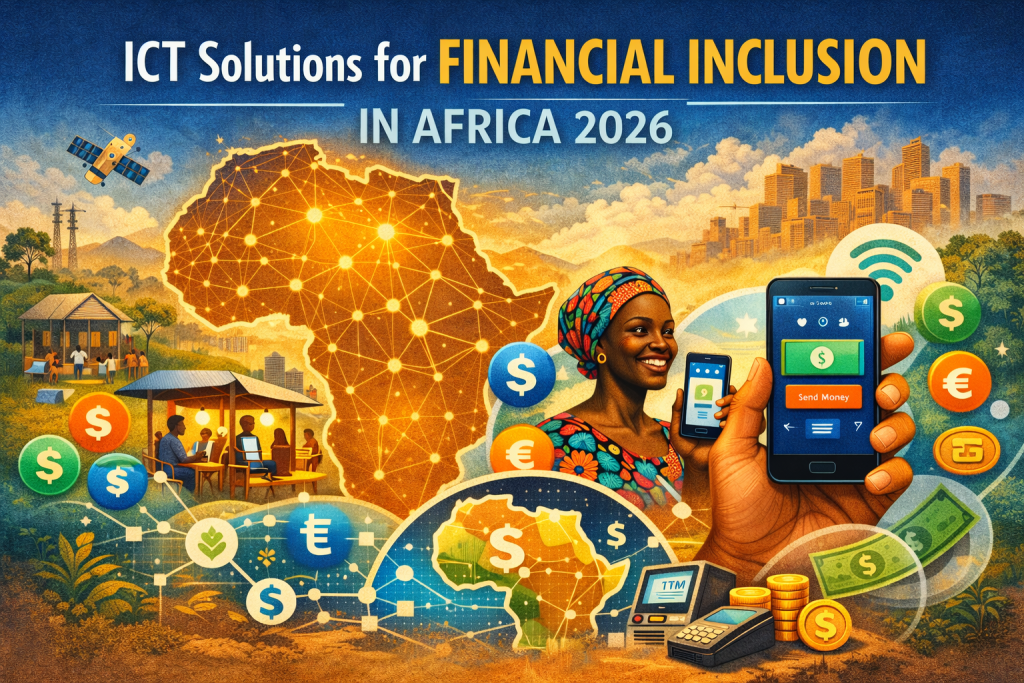
ICT Solutions for Financial Inclusion in Africa (2026)
In 2026, the narrative of African finance has shifted from “banking the unbanked” to “empowering the digitally active.” Information and Communication Technology (ICT) is no longer just a bridge; it is the foundational infrastructure of a new, inclusive economy. While traditional brick-and-mortar banking remains a hurdle for millions, the digital “rails” of 2026 have brought formal financial services to the fingertips of over 79% of adults across the continent (World Bank, 2025).
Here is how ICT solutions are fundamentally transforming financial inclusion in Africa today.
- The Evolution of Mobile Money & “Fintech 2.0”
Mobile money was Africa’s first great leapfrog. In 2026, this has evolved into “Fintech 2.0,” where simple SMS-based transfers have been replaced by sophisticated integrated ecosystems.
- Beyond Transfers: Modern mobile wallets now offer micro-insurance, automated savings, and fractional investment in government bonds.
- USSD & Offline Accessibility: Despite the rise of smart phones, USSD (Unstructured Supplementary Service Data) remains a lifeline, ensuring that the 15% of the population without internet access can still perform essential banking via basic feature phones.
- Agentic AI in Finance: AI “agents” now act as personal financial advisors for micro-entrepreneurs, helping them optimize cash flow and manage inventory through simple voice commands in local languages.
- Digital Identity: The New “Financial Passport”
The single greatest barrier to financial inclusion has historically been the lack of formal identification. In 2026, Africa has become the world’s largest laboratory for Digital ID (DID) systems.
- Biometric Verification: Countries like Nigeria, Kenya, and Rwanda have successfully scaled national biometric IDs that serve as “e-KYC” (Know Your Customer) rails. This allows a street vendor to open a bank account in minutes using only a thumbprint.
- Reducing Fraud: These verifiable digital identities have reduced “identity-related” fraud by nearly 40%, making it safer for banks to lend to individuals without traditional credit histories.
- Alternative Credit Scoring via AI and Big Data
The “unbanked” are rarely “data-poor.” In 2026, ICT platforms leverage alternative data to build credit profiles for the informal sector.
- Data Sources: Algorithms analyze mobile airtime top-ups, utility payments, and even e-commerce transaction patterns to determine creditworthiness.
- Instant Lending: Platforms like JUMO and Carbon use this data to provide instant, collateral-free loans to MSMEs (Micro, Small, and Medium Enterprises), which currently account for 60% of employment in Sub-Saharan Africa.
- Blockchain and Cross-Border Interoperability
Cross-border payments in Africa were once the most expensive in the world. In 2026, blockchain and the Pan-African Payment and Settlement System (PAPS) have revolutionized trade.
- CBDCs & Stablecoins: Several African central banks have launched or are testing Central Bank Digital Currencies (CBDCs) to reduce transaction costs and bypass the need for correspondent banking.
- Interoperability: The shift toward “Open Banking” means that a user in Ghana can send money to a mobile wallet in Kenya instantly and at a fraction of the cost of traditional wire transfers.
Comparative Impact of Digital Finance (2021 vs. 2026)
Metric | 2021 Status | 2026 Status (Projected/Current) |
Mobile Money Adoption | 27% of adults | ~40-45% of adults |
MSME Credit Access | High collateral required | AI-driven, data-based lending |
Cross-Border Fees | 8-10% per transaction | Under 3% via PAPS/Blockchain |
Identity Verification | Manual/Paper-based | Biometric/Digital ID Rails |
Challenges to Inclusion
While the progress is historic, two major “boss levels” remain for 2026:
- The Digital Divide: Ensuring that the rural poor are not excluded by the cost of data and smart phones.
- Regulatory Harmony: As fintech moves faster than law, regional regulators are under pressure to create “sandboxes” that protect consumers without stifling the innovation that drives inclusion.
Conclusion
In 2026, ICT has proven that financial inclusion is not a charity project—it is a massive market opportunity. By turning identity into infrastructure and data into credit, Africa is setting a global blueprint for how technology can create a more equitable financial world.
Reference
World Bank Group (2025). The Global Findex Database 2025: Connectivity and Financial Inclusion in the Digital Economy. > This report highlights that Sub-Saharan Africa remains the global leader in mobile money innovation, with 40% of adults now using mobile money accounts to save and pay, contributing to a 16-percentage-point increase in formal saving since 2021