
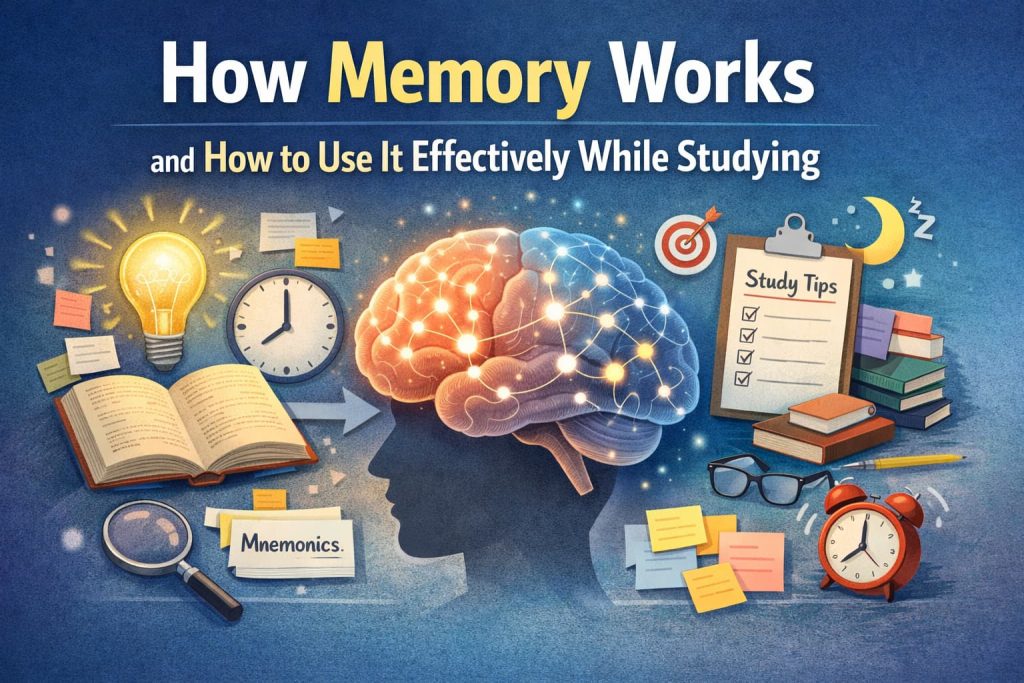
How Memory Works and How to Use It Effectively While Studying
Human memory is not a video recorder, it is a reconstruction system that constantly rebuilds information every time we recall it. Understanding its basic architecture helps students study smarter instead of just harder.
Three Core Stages of Memory
Encoding Information first enters through the senses which is transformed into a storable form (visual images, meaning, sound, story, emotion, etc.)
Storage / Consolidation Short-term / working memory (≈ 20–30 seconds without rehearsal) resulting in long-term memory (days, years, lifetime). Most consolidation happens during deep sleep.
Retrieval The moment we try to remember something: this is usually the weakest link during examinations.
The Forgetting Curve: The Enemy Every Student Faces Without deliberate review, we forget approximately 50–80% of new material within 24 hours and approximately 90% within one month.
The solution: strategic, timed review dramatically flattens the curve.
The Most Powerful, Evidence-Based Study Techniques
Rank | Technique | What you actually do | Strength / Main Benefit | Best Tool / Method |
1 | Active Recall | Close the book → write/sayfrom memory | Strongest single booster of long-term retention | Flashcards, blank-page recall, self-quiz. |
2 | Spaced Repetition | Review at increasing intervals (1 day to 3 days to 1 week to 1 month) | Beats the forgetting curve most efficiently | Anki, Quizlet, physical flashcard system |
3 | Feynman Technique | Explain the concept in very simple words (as if teaching a 12-year-old) | Exposes gaps + builds deep understanding | Write explanation to simplifyingand finding gaps to repetition repeat |
4 | Interleaving | Mix different topics/types of questions in one session | Improves ability to discriminate & apply knowledge | Mixed past questions instead of topic blocks |
5 | Elaboration | Connect new information to what you already know | Creates richer memory networks | “This is like…”, “This explains why…” |
Quick Study Smarter Routine (use this sequence)
- Learn once → make your own short summary / mind-map
- Active recall – write everything you can remember (no peeking)
- Check & correct → fill gaps
- Feynman – explain aloud or in writing (very simply)
- Enter into spaced-repetition system
- Sleep well + do light exercise the next day
Note: Students who consistently apply active recall and spaced repetition usually outperform classmates who only re-read notes or highlight textbooks often by a very large margin.