
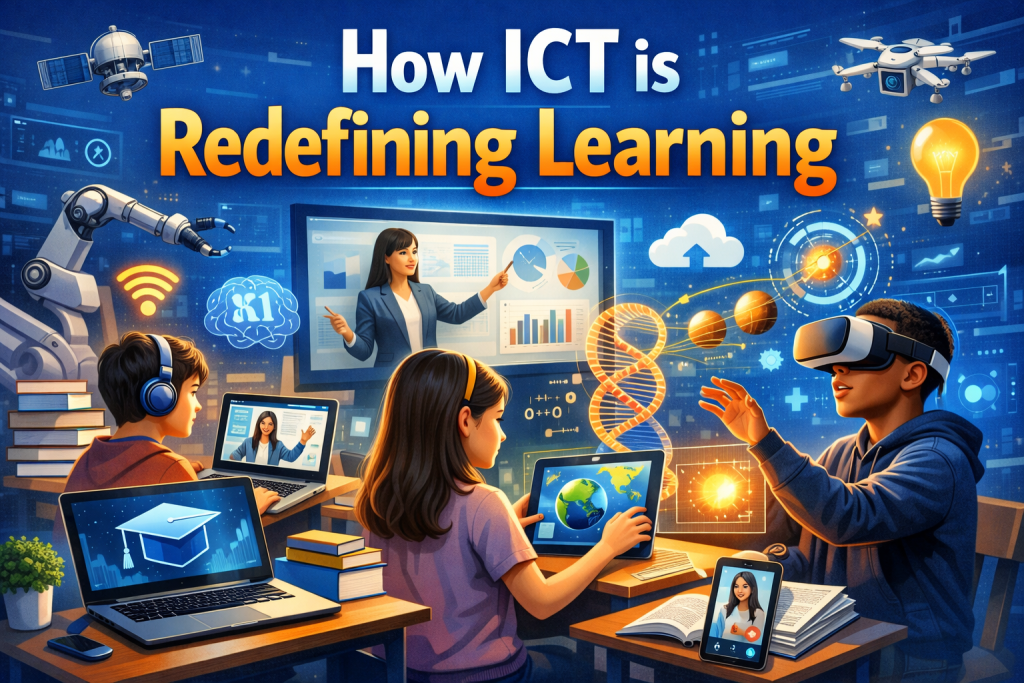
How ICT is Redefining Learning
For decades, the “factory model” of education, one teacher, thirty students, and a single pace, dominated the landscape. Today, ICT is dismantling that model in favor of a Personalized Learning Ecosystem.
The Rise of the “AI-Human” Co-Creation
In 2026, Generative AI (GenAI) has moved beyond simple chat bots. Students now work with multi-agent AI systems that act as personal tutors, research assistants, and editors. According to recent surveys, nearly 90% of higher education students now use GenAI to explain complex concepts or simulate Socratic debates (HEPI, 2025). This shift moves the focus from “content memorization” to “higher-order thinking” and “prompt engineering.”
- Immersive Classrooms: Beyond the Screen
Virtual and Augmented Reality (VR/AR) have matured into essential pedagogical tools. History students no longer just read about the Industrial Revolution; they walk through digital twins of 19th-century factories. Medical students perform complex surgeries in risk-free haptic environments. These immersive experiences are proven to increase knowledge retention rates by up to 45% compared to traditional methods (Hurix Digital, 2026).
- Hyper-Personalization through Predictive Analytics
Educational institutions are now using “Learning Analytics” to predict student success. By analyzing interaction data in real-time, AI platforms can identify when a student is likely to struggle with a mathematical theorem before they even fail a quiz. This allows for preemptive intervention, ensuring that learning gaps are closed as soon as they appear.
The Shift in Credentials: Micro-Badges and Skills
The future of education is also changing the currency of learning. We are seeing a move away from the four-year degree as the sole measure of value.
- Micro-credentials: Short-form, tech-verified certifications are becoming the standard for job readiness.
- Block chain Records: Digital badges and academic transcripts are increasingly stored on decentralized ledgers to ensure security and instant verification by global employers (TCS, 2026).
Critical Challenges: The Digital Divide and Ethical Guardrails
While the potential of ICT is boundless, 2026 has also highlighted significant hurdles:
- The New Digital Divide: While some students learn via VR, others still lack stable broadband. Bridging this gap remains a top priority for global alliances.
- Data Privacy & Ethics: With more student data being collected than ever, “Confidential Computing” and robust “AI Guardrails” are essential to protect minor privacy and prevent algorithmic bias (EdTech Magazine, 2025).
- Teacher Reskilling: The role of the teacher has shifted from “Lecturer” to “Learning Architect.” Educators now need continuous professional development to manage high-tech, hybrid environments effectively.
Conclusion: A Human-Centric Future
The future of education is not about replacing humans with machines; it is about using ICT to amplify human potential. As we move further into 2026, the most successful educational models will be those that blend high-tech efficiency with high-touch empathy.
Education is becoming more accessible, more engaging, and more aligned with the needs of a digital society. The classroom of the future is not a place—it is a global, connected experience.
References
Computeam (2025). What are the Key Advantages of ICT in Education in 2025? Focuses on AI-assisted platforms and the integration of Google’s LearnLM.
- HEPI – Higher Education Policy Institute (2025). Student Generative AI Survey 2025. A critical report on the rapid uptake of AI tools in undergraduate education.
- Hurix Digital (2026). 11 Trends in Education Technology That Will Have a Major Impact in 2026. Highlights the growth of mLearning and the 45% retention increase in digital environments.
- Lamalif, L., et al. (2024). Toward a New Model for the Successful Implementation of ICT in Education. Frontiers in Education. A peer-reviewed look at the MIPTICE model for pedagogical alignment.
- Tata Consultancy Services (TCS) (2026). Emerging Higher Education Tech Trends in 2026. Explores the role of XR (Extended Reality) and blockchain in academic modernization.