
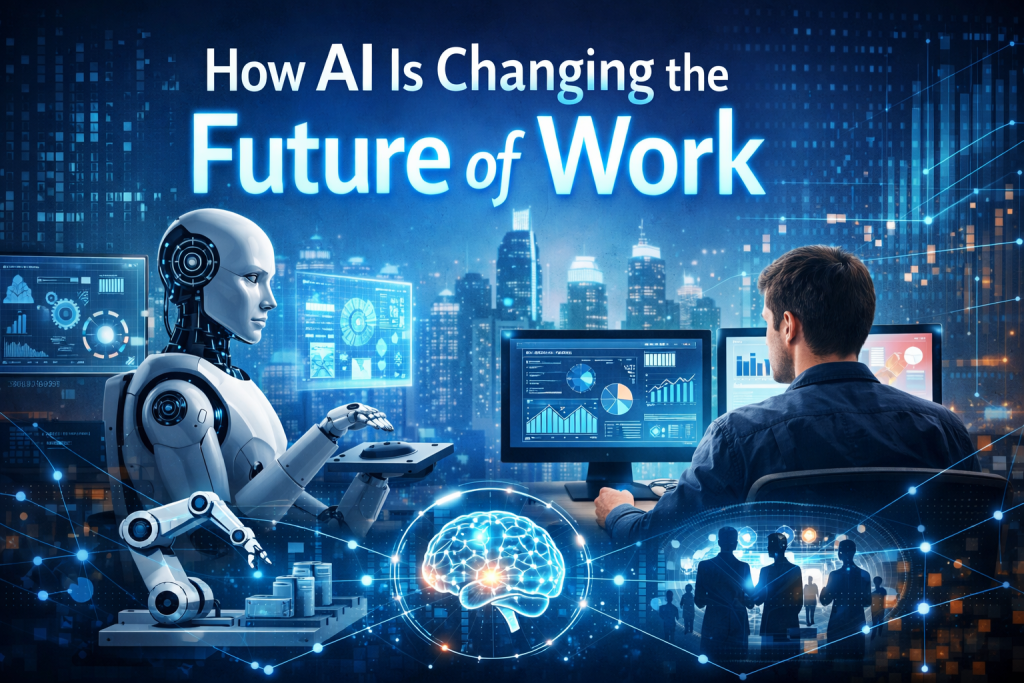
How AI Is Changing the Future of Work
Artificial Intelligence is no longer experimental. It is operational. From boardrooms to classrooms, from factories to finance desks, AI is quietly reshaping how work gets done. The question is no longer if AI will influence the workforce but how deeply and how fast.
Here’s what the evidence shows.
1.Automation of Routine Tasks
AI is taking over repetitive, rule-based tasks data entry, scheduling, basic customer service, document review. Tools powered by generative AI, such as OpenAI’s systems, are accelerating productivity in writing, coding, and research.
According to the World Economic Forum (Future of Jobs Report 2023), automation and AI are expected to significantly reshape nearly 25% of jobs globally within the next few years. However, this does not simply mean job loss it means job redesign.
Impact:
- Administrative roles evolve into analytical roles
- Workers shift from doing tasks to supervising systems
Productivity increases where AI is integrated effectively
2. Creation of New Job Categories
History shows that technology eliminates some roles but creates others. AI is already generating demand for:
- AI trainers and prompt engineers
- Data scientists and AI ethicists
- Cybersecurity analysts
- Automation specialists
The International Labor Organization reports that AI is more likely to augment jobs rather than fully replace them, especially in high-skilled sectors.
Reality check: The workforce will not shrink it will transform.
3. Rise of Human-AI Collaboration
The future workplace is not human versus machine. It is human with machine.
Research by McKinsey & Company estimates that by 2030, up to 30% of work hours globally could be automated. Yet, human skills judgment, creativity, leadership, emotional intelligence remains difficult to replicate.
AI handles:
- Data processing
- Pattern recognition
- Predictive analysis
Humans focus on:
- Strategic thinking
- Ethical decisions
- Relationship management
The competitive edge will belong to professionals who understand how to leverage AI rather than fear it.
4. Redefinition of Skills
Technical literacy is becoming foundational. But beyond coding, the critical skills of the AI era include:
- Critical thinking
- Complex problem-solving
- Digital literacy
- Adaptability
- Continuous learning
The OECD emphasizes that lifelong learning systems must evolve to keep pace with technological disruption.
Organizations that fail to upskill their workforce risk obsolescence.
5. Ethical and Governance Challenges
AI introduces serious concerns:
- Bias in algorithms
- Data privacy
- Job displacement
- Regulatory gaps
Governments worldwide are responding. The European Union has introduced the AI Act to regulate high-risk AI systems, signaling that governance will play a major role in shaping AI’s impact on work.
Ethical AI is not optional it is a strategic necessity.
The Strategic Outlook
AI is not the future of work.
It is the present driver of workplace evolution.
Organizations must:
- Invest in digital skills
- Redesign roles, not just cut costs
- Build human-AI collaboration frameworks
- Prioritize ethical implementation
Workers must:
- Embrace continuous learning
- Develop adaptable skill sets
- Position themselves as value creators, not task executors
The future of work will belong to those who combine technological competence with human wisdom.
References
- World Economic Forum. Future of Jobs Report 2023.
- International Labour Organization. Generative AI and Jobs: A Global Analysis of Potential Effects on Job Quantity and Quality (2023).
- McKinsey & Company. The Future of Work After COVID-19 (Updated Insights on Automation).
- OECD. OECD Employment Outlook & Skills Reports.
- European Union. EU AI Act Framework.