
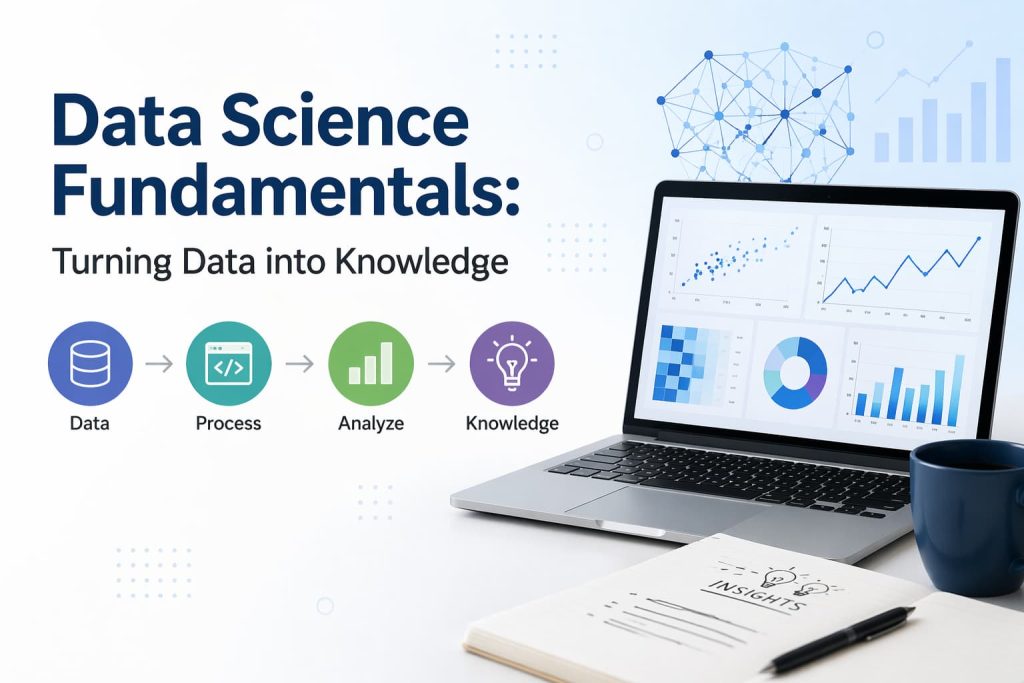
Data Science Fundamentals Turning Data into Knowledge
In today’s data-driven world, vast amounts of data are generated across industries through transactions, digital interactions, and automated systems. However, raw data alone has little value unless it is processed and transformed into meaningful insights. Data science enables this transformation by converting data into knowledge that supports informed decision-making, innovation, and value creation.
Data science is a multidisciplinary field that integrates statistics, programming, domain expertise, and communication skills to extract meaning from complex datasets. It goes beyond simple data analysis by incorporating advanced techniques such as machine learning and predictive modeling to uncover patterns and trends within large datasets.
Concept of Data Science
Data science can be defined as the process of extracting useful insights and knowledge from data. It is built on statistics and mathematics, computer science, domain knowledge, and communication skills. Unlike traditional statistical methods that rely on small datasets, data science works with large and complex real-world data. Its main objective is to transform data into actionable decisions.
The Data Science Lifecycle
The process of transforming data into knowledge follows a structured and iterative approach:
Problem Definition: Identifying a clear objective ensures that the analysis remains focused and relevant.
Data Collection: Relevant data is gathered from sources such as databases, surveys, and web platforms.
Data Cleaning and Preprocessing: This involves handling missing values, removing duplicates, and correcting inconsistencies.
Exploratory Data Analysis: Data is examined using statistics and visualization to identify patterns and trends.
Feature Engineering and Modeling: New variables are created and machine learning models are applied.
Evaluation and Interpretation: Models are tested and results are interpreted based on the problem context.
Deployment and Monitoring: Models are implemented and continuously monitored for performance.
Communication of Insights: Findings are presented clearly for decision-making.
Essential Skills and Tools
Key skills required in data science include programming, statistical analysis, data visualization, database management, and critical thinking.
Importance and Applications
Data science is widely applied in business, healthcare, finance, and technology. It helps organizations predict trends, detect fraud, improve decision-making, and optimize operations.
Getting Started in Data Science
Beginners should learn programming basics, practice with real datasets, complete projects, and build a portfolio to demonstrate their skills.
Conclusion
Data science plays a vital role in transforming raw data into meaningful knowledge. It supports effective decision-making and innovation, making it an essential skill in today’s world.